Genesis College offers Scholarships of Up to 100% for Students Entering 9th Grade
Jun 16, 2026
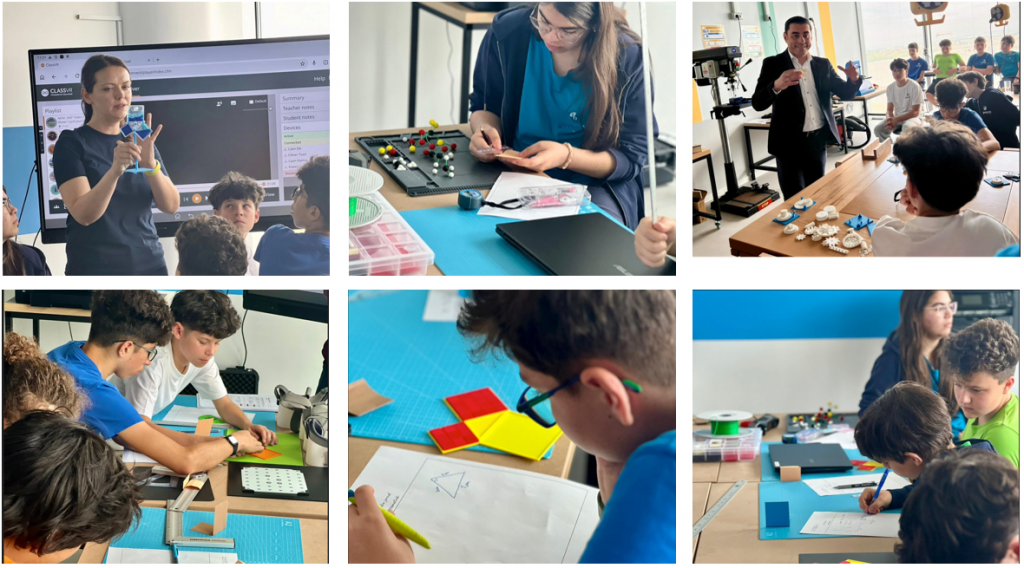
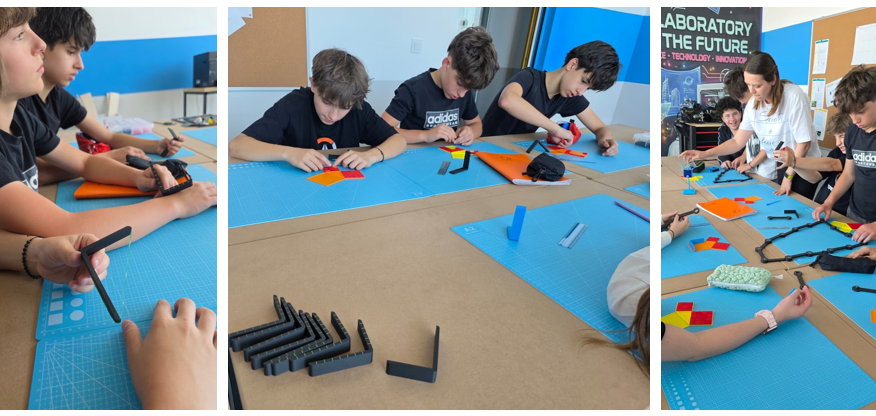
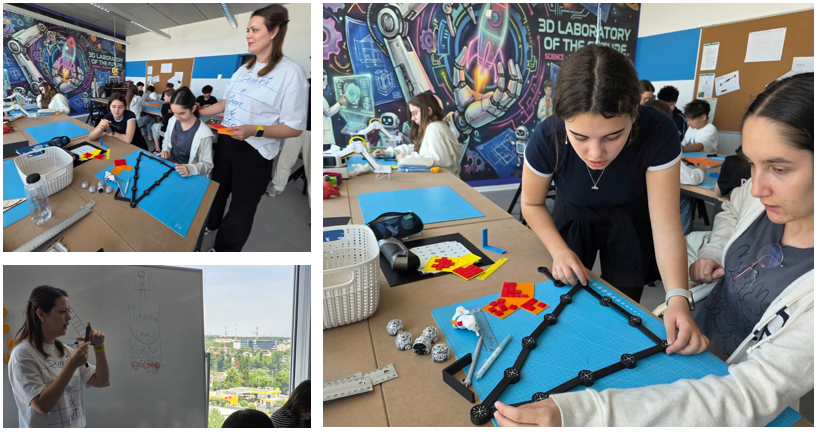
During the math lesson on the Pythagorean Theorem, held at the IDeA HUB within Genesis College, a private school, with sixth-grade students, we focused not only on understanding the formula but also on verifying it practically through measurement, construction, and experimentation.
Starting from an example presented during the lesson, the construction of a ladder leaning against a wall, the students analysed the sides of a right triangle measuring 6 meters and 8 meters, respectively, with the goal of determining the hypotenuse, that is, the length of the ladder.
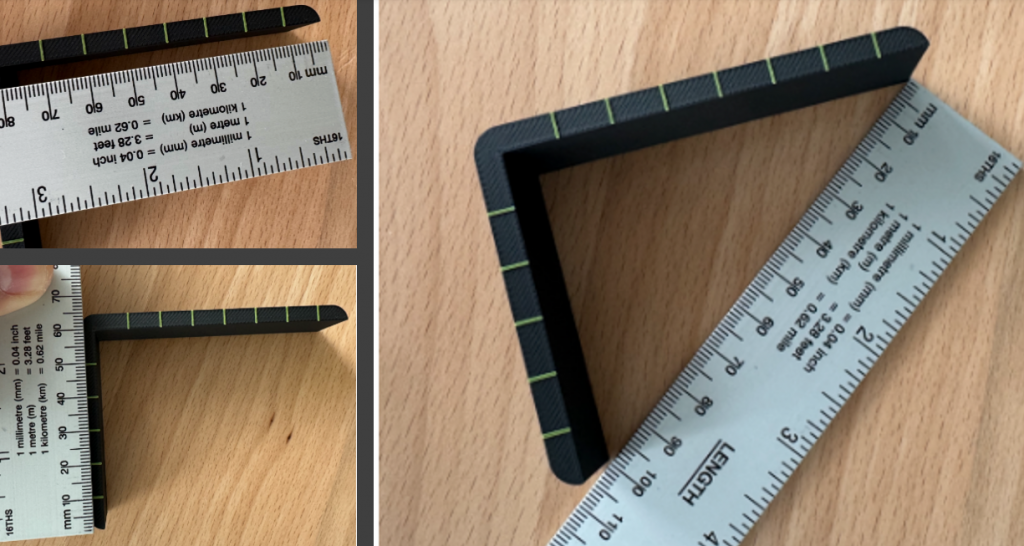
To turn the exercise into a hands-on experience, we used 14-cm pieces of cardboard that were folded to create two perpendicular sides of 6 cm and 8 cm. The students then measured the hypotenuse using various tools: a ruler, a tape measure, a caliper, and a protractor.
The activity also served to familiarise them with the proper use of real measuring instruments, frequently used in technical laboratories and in design and engineering activities. During the measurements, however, I noticed a significant problem: the cardboard did not consistently maintain a perfect 90° angle, leading to variations in the results. The measured values were close to 10 cm, but they were not exact.
This situation became a valuable point of discussion regarding precision, measurement errors, and the importance of using the right tools in science and technology.
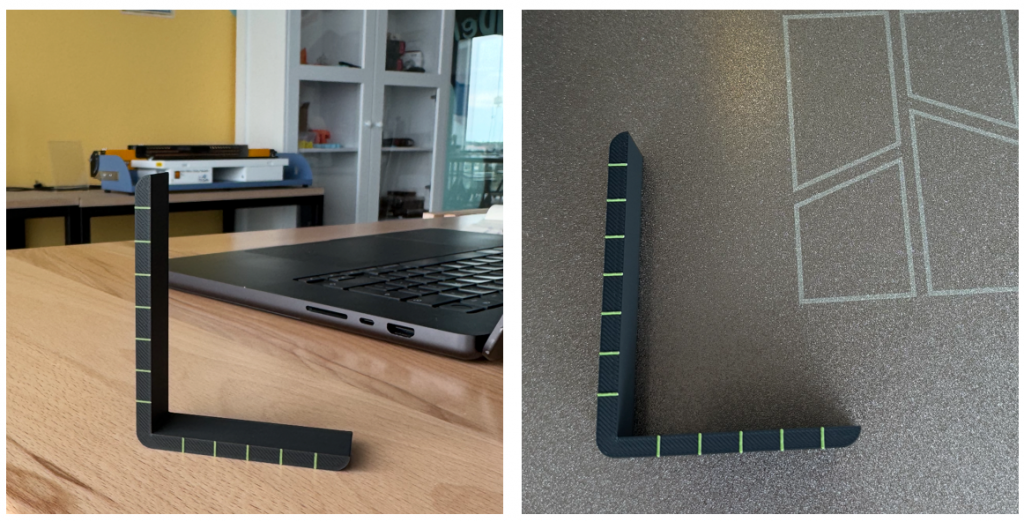
After the lesson at the IDeA HUB, we analysed how the activity could be improved to save time and reduce the number of errors. The solution was to design and 3D-print a new educational object: two rigid legs of a right-angled triangle, with sides of 6 cm and 8 cm and 1 cm graduations.
The new object maintains a right angle at all times and allows for much more precise measurements of the hypotenuse, with students now obtaining values very close to the correct result of 10 cm. The object was tested in class and remains in the IDeA HUB resource database, to be reused and developed in future interdisciplinary activities, registered under inventory number MATH_003_Echer_Pythagora_6-7.
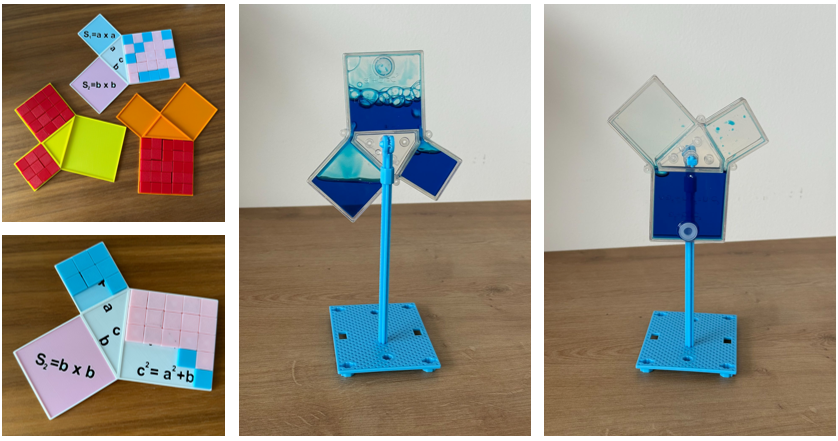
During the same lesson, other 3D-printed materials were also used to visualize the relationship between the squares constructed on the sides of the right triangle, so that students could “see” and practically verify this relationship.
IDeA HUB remains a space open to collaboration among teachers, where lessons can be transformed into practical, interactive, and relevant experiences for students, right here at Genesis College. Teachers interested in developing similar activities are encouraged to use the lab and available resources to test new ways of teaching and learning.
Ioana Rolea, MYP Mathematics Teacher @ Genesis College
“As a math teacher, I believe one of the most important challenges in teaching is transforming abstract concepts into concrete, accessible, and memorable experiences for students. During this activity at the IDeA HUB, students did not simply apply a formula from a textbook; instead, they discovered the relationship between the sides of a right-angled triangle through observation, measurement, and practical verification.”
The use of 3D-printed materials added significant value to the lesson, enabling students to handle the objects, compare results, and better understand why the Pythagorean Theorem works. Additionally, the activity developed essential skills such as attention to detail, observational skills, teamwork, and critical thinking.
Another valuable aspect was the connection made between mathematics and fields such as engineering, design, and digital technology. Students realised that maths isn’t just about solving problems on paper but is a real-world tool used in construction, architecture, technical design, and more. Activities like this help boost motivation for learning and encourage students to view maths in a practical, modern, and applied way.
The activity at IDeA HUB demonstrated the importance of students being actively involved in the learning process. When they can experiment directly and verify results through their own measurements, their understanding increases considerably. Students were much more attentive and engaged than in a traditional lesson, as each step involved discovery, collaboration, and practical application. Furthermore, the use of 3D printing in math lessons opens new opportunities to develop educational resources tailored to students’ needs. The objects created can be reused, improved, and integrated into other topics in geometry or measurement. Through such activities, technology becomes a real support for teaching, and students are able to more easily make the connection between theory and practice.
This lesson confirms that interdisciplinary learning positively impacts students’ motivation and curiosity. Combining mathematics with elements of design, measurement, and the use of technical tools transforms the lesson into an authentic context for exploration. At the same time, students develop confidence in their own abilities and understand how mistakes or measurement discrepancies can become valuable opportunities for analysis and learning.”
Authors:
Ioana Rolea, MYP Mathematics Teacher
Cristian Lăcraru, Director of Design, Technology & Innovation