
RTPR | Radu Tărăcilă Pădurari Retevoescu SCA: RTPR advises Resource Partners on iaBilet.ro exit
Jul 24, 2026
Many executives are promoted for reasons that don't necessarily predict leadership effectiveness. They excel at impressing the people above them with confidence, vision, and networking skills. Yet these qualities are not always the ones that build, inspire, and sustain high-performing teams.
Leadership research has traditionally faced a similar challenge. Most studies focus on people who already hold leadership positions—examining what helped them get promoted and how they lead once in those roles. Far fewer studies ask the people being led what they actually value in a leader or which leadership behaviors help them perform at their best.
Hogan Assessments, a global leader in personality assessment and leadership development, conducted the Global Leadership Effectiveness Study by surveying nearly 10,000 people worldwide to understand what individuals truly expect from their leaders. The findings were then compared with personality data from more than 21,000 executives in Hogan's global database, providing valuable insights into the characteristics associated with effective leadership.
What they found out? The executives organizations tend to reward are often not the leaders their people want to follow. This disconnect costs organizations time, talent, and revenue.
Below, Garrett Shaffer, Regional Director – Europe at Hogan Assessments, and Ryne Sherman, Chief Science Officer at Hogan Assessments, share their perspectives on these findings, what they mean for leaders, and their implications for organizations.
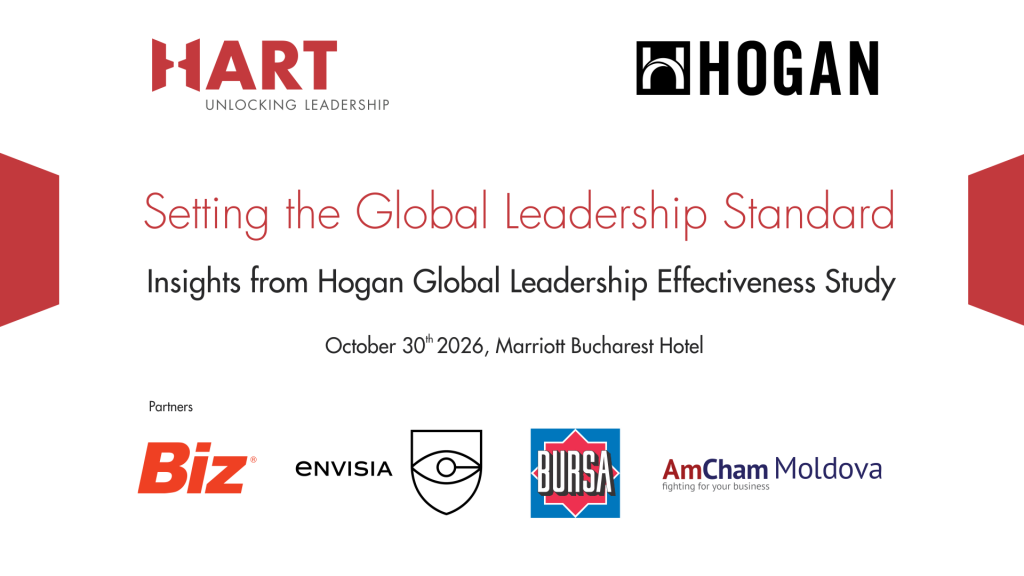
Garrett Shaffer will also be the keynote speaker at Hart Consulting's event on October 30th, Setting the Global Leadership Standard: Insights from the Hogan Global Leadership Effectiveness Study. Discover more about the event: https://www.hartconsulting.eu/en/hr-strategic-conference/setting-the-global-leadership-standard/
If there are so many discrepancies between what competencies leaders demonstrate and what employees actually want, what are we really selecting for in leadership today?
Garrett: This is a common challenge organizations face: how to identify the right individual for a critical leadership role. In practice, many selection decisions are driven by indicators of leadership emergence—favoring individuals who are highly visible, skilled networkers, compelling communicators, or those who can confidently promote an ambitious vision. While these traits often help individuals stand out and advance into leadership positions, Hogan’s research makes a clear distinction: the qualities that drive emergence are not always the same as those required for leadership effectiveness. At senior levels, success is defined less by visibility and influence, and more by the ability to build, develop, and sustain high-performing teams. As a result, organizations that over-index on emergence indicators may achieve short-term momentum but risk selecting leaders who struggle to deliver consistent, long-term performance.
Why do organizations keep promoting leaders based on visibility and assertiveness, when employees consistently value trust, integrity, and communication more?
Garrett: We often see that the traits that get someone noticed within an organization include traits such as assertiveness, charisma, confidence, or even competitiveness. These qualities make people appear “leader-like,” and decisions to promote them are often based on these more “visible” behaviors. This can also cause leadership pipelines to become self-reinforcing. Leaders who succeed through visibility and assertiveness tend to promote others who resemble themselves, perpetuating the cycle.
Why do some individuals rise faster into leadership roles, even when their personality traits may later undermine their effectiveness?
Garrett: Some individuals rise quickly into leadership roles because the traits that help people emerge as leaders are not always the same traits that help them succeed as leaders over time. Hogan distinguishes between Leadership Emergence—who gets noticed, promoted, or selected—and Leadership Effectiveness—who has the ability to build and maintain a high-performing team. We often see that leaders who rise quickly display traits such as confidence and assertiveness, but these may only lead to short-term wins or prove ineffective in supporting the long-term development of individual team members. When leaders understand the individual needs of their team members, they can leverage different strengths and values to be most effective.
What does Hogan data reveal about the difference between the personality of leaders who emerge and those who are actually effective once in the role?
Ryne: Our data shows a substantial divide between the people who emerge as leaders and take on leadership roles compared to those who are skilled at building a high-performing team. People who are more likely to emerge as leaders tend to be ambitious, confident, charismatic, socially skilled, and offer big visions for the future. People who are effective at leading, on the other hand, tend to have high integrity, a deep understanding of their organization, make good decisions with limited information, and have the humility to reverse course when they’ve made a mistake.
Which personality characteristics help leaders get ahead — but become liabilities at the top of the organization?
Garrett: Imagine you promoted a high potential to lead an important new division. They impressed executive team with dynamic presentations that highlighted her successes. He was known as a skilled networker, connecting with colleagues from nearly every department. And even before scoring the promotion, he proactively shared a 12-month growth plan that was both bold and ambitious. The C-suite thought he was the perfect choice for the role. Unfortunately, his team members didn’t think so. In the six months after his promotion, half of his team resigned because they were unable to tolerate his ego and moodiness. Colleagues from various departments filed complaints against him, citing temper tantrums and inappropriate behavior. Instead of achieving the promised growth, he alienated others and caused problems for executive leadership and HR to solve. What went wrong here? This high potential failed to support his team—and gain their trust—because he was so focused on his own goals, achievements, and vision. This isn’t a unique failure. It’s a predictable outcome of how organizations tend to choose emergent leaders over effective leaders when promotions or other opportunities for advancement arise.
What are the hidden organizational costs — emotional, cultural, and reputational — of promoting leaders based on emergence rather than effectiveness?
Ryne: Leadership has an outsized impact on any organization with huge consequences for the people in it. In the corporate world, the CEO alone accounts for somewhere between 17-29% of the variability in firm financial performance. But these numbers are not driven by simple financial decisions. Everything the CEO does shapes the culture and the values of the organization, which directly impacts engagement, which directly impacts the firm’s bottom line. Emergent leaders create a culture of self-interest which hampers engagement, increases turnover, and ultimately hurts firm financial performance.
Why is relationship-building emerging as a critical leadership capability globally, yet still undervalued at executive level?
Ryne: Trust is the foundation of every relationship. If you do not trust your business partner, your business is doomed to fail. If you do not trust your romantic partner, your romance is equally doomed. Yet, globally, trust in our institutions – governments, courts, religious organizations, medical and scientific organizations – is at an all time low. Trust is built one relationship at a time. Thus, building relationships grounded in integrity is crucial for rebuilding trust between leaders and employees. At the executive level, relationship building remains undervalued because there is an inherent tendency to fall in love with individuals who provide a compelling vision for the future, rather than those who offer integrity and competence.
Are employees asking for fundamentally different leaders than they did 10 years ago — or are organizations just failing to listen?
Ryne: Employees are still asking for the same kinds of leaders today as they did a decade ago. In fact, followers are still asking for the same kind of leaders they asked for thousands of years ago. That is, the qualities of effective leadership – integrity, competence, decision-making, humility, selflessness – haven’t changed in thousands of years. Unfortunately, leadership often comes with privileges which inherently attract the greedy, self-interested, and grandiose leaders who often take advantage of their positions of authority for personal gain.
Which “dark-side” tendencies are most likely to derail leaders globally — and are they becoming more common?
Garrett: The traits we tend to see in leaders who get promoted are consistent with those observed throughout history. Hogan’s executive benchmark shows that many leaders in place today are confident and assertive, though at times they may come across as arrogant. They are often charming and willing to take risks, but can also be prone to testing limits. Many are entertaining and outgoing, yet may occasionally seem overly dramatic, while others are insightful and original but can come across as eccentric or unfocused. These characteristics often serve executives well, helping them take charge, influence others, and think creatively. However, when leaders stop actively self-monitoring, the overuse of these strengths can begin to alienate their teams. This is what Hogan refers to as “dark-side” tendencies.
If leadership is a matter of reputation, not intention, what does the data tell us about how leaders are really perceived today? What do Hogan personality data reveal about the actual profile of today’s leaders — not the ideal one? Some key points.
Ryne: The leaders we have today are seen as ambitious, skilled at networking, and creative. At the same time, they are also seen as overconfident, charming, charismatic, and unrealistic. They often make decisions based on their experience and gut-feelings rather than hard data. Ideal leaders would focus more on what is good for the group, and less on what is good for themselves by showing more humility, integrity, and using data to drive decision-making.
Join Hart Consulting on October 30th to explore the gap between what employees expect from their leaders and how today's leaders actually show up - through their values, everyday behaviors, responses under pressure, and leadership competencies. Together with our guest speakers, we'll explore what these findings mean for organizations and how they can shape more effective leadership selection and development practices.