CommunicationPress Releases
AMCHAM BUSINESS BAROMETER 2026: Political Instability, Inflation, and the Budget Deficit Are the Main Causes for Lower Investment Plans
AMCHAM BUSINESS BAROMETER 2026: Political Instability, Inflation, and the Budget Deficit Are the Main Causes for Lower Investment Plans
The results of the 8th edition of AmCham Romania’s survey on the quality of Romania’s investment and business climate indicate growing investor caution amid economic vulnerabilities and prolonged political instability. While companies expect operating results in 2026 to remain broadly comparable to previous years, medium-term investment and expansion plans (3–5 years) are more reserved, and confidence in economic growth prospects has declined significantly, with most respondents expecting stagnation.
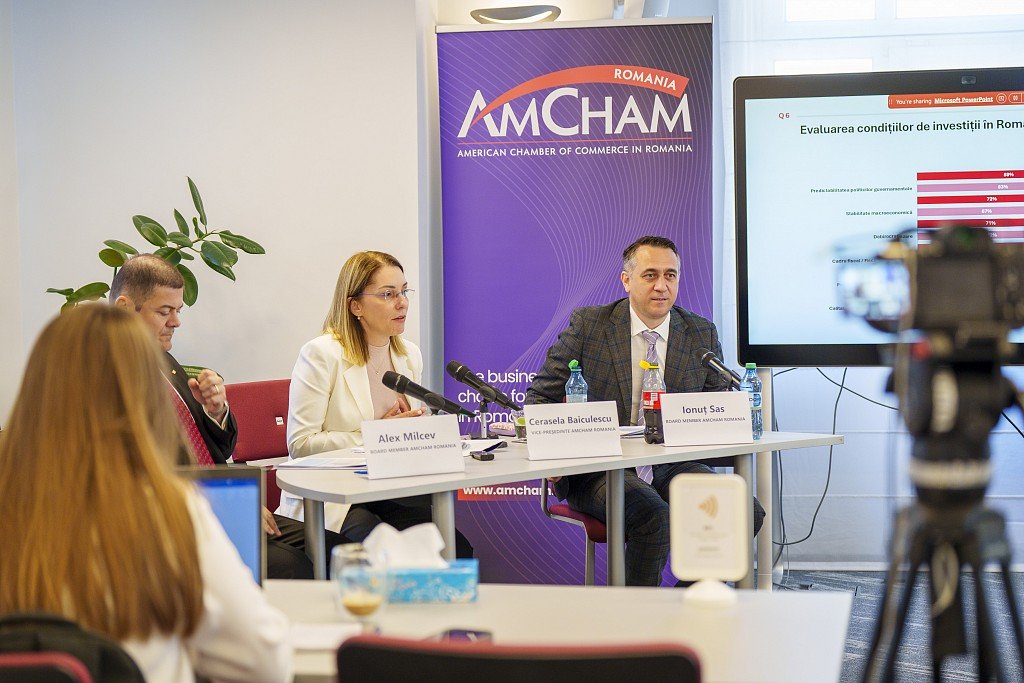
Conducted between April and May 2026 among AmCham Romania member companies, the Barometer highlights how the business community assesses Romania’s investment climate, competitive advantages, macroeconomic risks, business outlook, and the public policy priorities considered essential for the country’s competitiveness.
“AmCham members send a clear message this year: investor confidence in Romania’s potential can no longer be sustained in the absence of structural reforms and stronger capacity to implement complex projects. While the business community has demonstrated resilience and absorbed the impact of fiscal and budgetary measures adopted to reduce the deficit, the prolonged period of instability and the postponement of structural reforms are discouraging new investment and widening the gap with economies that rapidly integrate technological advances,” said Vlad Boeriu, President of AmCham Romania.
The findings point to a shift in business sentiment, marked by a more cautious approach of investors who pay increasing attention to domestic risks, and have stronger expectations for accelerated reforms and greater predictability.
Key findings of the AmCham Business Barometer include:
Resilience and a cautious outlook: Responses regarding business performance indicate resilience and positive results for many companies in 2025, but considerably more cautious expectations for 2026. The strongest signal comes from investment plans: fewer companies intend to invest, while more are postponing major decisions until greater predictability emerges. This trend reflects concerns related to the economic outlook, macroeconomic imbalances, and the pace of reforms.
Declining short-term investment appetite (12 months): One of the most important findings of this year’s edition is that 40% of companies do not plan new investments over the next 12 months, the highest level recorded in recent years. Only 3% of respondents plan investments exceeding EUR 100 million, investments considered strategic due to their significant multiplier effect across the economy. Foreign direct investment statistics in Romania and neighboring countries confirm the reality that investors are increasingly comparing opportunities across the region, while predictability, stability, and the continuation of reforms play a decisive role in capital allocation decisions.
Declining medium-term expansion plans (3–5 years): The intention to expand business activity recorded the sharpest decline of the analyzed period, falling from 65% last year to 55% in 2026, as companies shifted from growth plans toward consolidation and maintaining existing operations (from 30% last year to 40% in 2026).
The labor market remains a key determinant of economic competitiveness: Labor market pressures continue to ease gradually (75% of respondents described the labor market as “tight,” down from 83% last year), but the challenge is evolving rather than disappearing. For companies, the main issue is increasingly not workforce availability itself, but the availability of the relevant skills to drive economic competitiveness. Overall, the results suggest that labor market challenges are both quantitative and increasingly qualitative. This is why education reform, skills development, and lifelong learning must become strategic priorities for Romania.
Romania’s most valuable competitive advantages: Membership in the European Union (96%) and NATO (70%) reached the highest levels of appreciation measured by the AmCham Barometer Survey, alongside human capital (65%) and market size (59%), both of which also improved. This comes at a time when security and geopolitical stability increasingly influence investment decisions.
Competitive advantages that attract investment: The results confirm that Romania continues to benefit from several important competitive advantages, particularly in the digital and tech sectors. Among the most highly rated market conditions are the quality of cybersecurity infrastructure (43%) and digital infrastructure (39%). The challenge is to support these strengths through sustained reforms and investments that increase the digitalization of public administration and public services while preventing competitiveness gaps that could affect long-term growth.
Challenges for investors and the broader economy: The concerns highlighted by the business community are not new but largely reflect structural issues that have persisted for years. Predictability of government policies is rated as poor or very poor by 89% of respondents, macroeconomic stability by 72%, and progress in reducing bureaucracy by 72%. At the same time, the fiscal framework, economic policy, and transport infrastructure recorded moderate improvements compared to last year. While encouraging, these developments are not yet strong enough to significantly improve overall perceptions of the business, as more than half of respondents continue to rate each area as poor or very poor.
Growing impact of domestic risks: Political instability is identified as a major risk factor by 89% of respondents, up 20 percentage points from last year, followed by inflation and rising fixed costs, which increased from 61% to 88%, and the budget deficit and public debt, which increased from 74% to 80%. These results confirm the shift in business concerns toward domestic risks.
Impact of global trends: Military conflicts and geopolitical risks remain the factors with the greatest impact on business activity, cited by 72% of companies. Artificial intelligence also remains among the most influential trends affecting companies (61% in 2026, compared to 71% in 2025), indicating that the focus is increasingly shifting from disruption toward integration as a tool for efficiency, innovation, and productivity growth. Climate change has moved lower on the list of concerns (16%) as companies prioritize economic and geopolitical risks perceived to have a more immediate impact on their operations.
Public policy priorities for the economic agenda: Responses indicate that Romania must continue on two parallel tracks: accelerating reforms and investments already underway, while strengthening long-term economic fundamentals such as education, healthcare, and innovation. For more than half of respondents, policy priorities should include the digitalization of public services (64%), infrastructure investment (63%), effective absorption of European funding (62%), and maintaining a competitive tax system (53%).
Corruption continues to significantly affect the business environment: More than two-thirds of the companies report experiencing the direct effects of corruption, while nearly nine out of ten state that they are indirectly affected. These results highlight the systemic nature of corruption’s impact on the business environment. Companies associate corruption with additional costs, uncertainty, and competitive distortions that undermine the efficient functioning of the economy and the relationship between the private sector and public institutions.
Economic outlook points to stagnation: 57% of respondents expect the Romanian economy to stagnate, while 22% anticipate economic contraction. Only 21% expect economic growth in 2026, compared to the 2024 edition, when more than half of respondents held a positive outlook. From this perspective, the business community appears to have shifted from expecting a recovery to adapting to a more complex and volatile environment.
The Barometer results suggest that Romania continues to benefit from important anchors of confidence - EU and NATO membership and significant strengths, including the quality of its human capital, market size, and cybersecurity capabilities. However, these advantages alone are no longer sufficient for Romania to remain competitive in a rapidly changing global economy.
Romania must complement these strengths with greater predictability, reforms, and implementation capacity. This is the condition for transforming the country’s economic potential into investment, jobs, and long-term prosperity.
About the AmCham Business Barometer
The AmCham Business Barometer is the annual survey conducted by the American Chamber of Commerce in Romania to assess member companies’ perceptions and expectations regarding the investment climate, economic outlook, and public policy priorities.
Survey responses were collected between April and May 2026, and the findings reflect the views of 159 member companies: 48% large taxpayers, 43% medium-sized taxpayers, and 9% small taxpayers.