
ACTIVE LEARNING IN ACTION
Jul 22, 2026
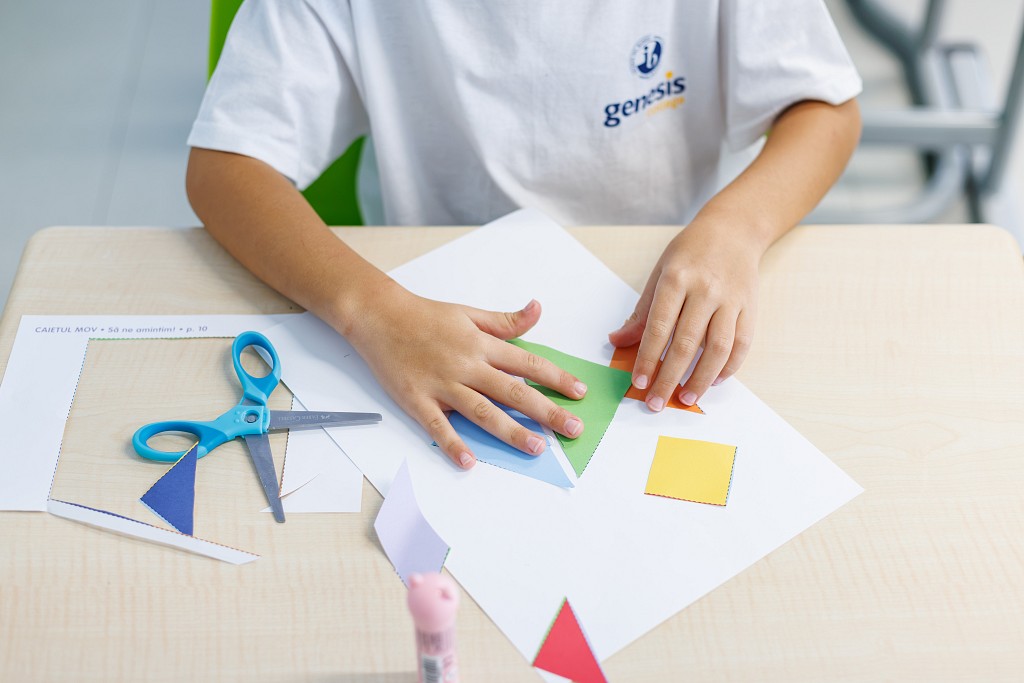
What does mathematics look like when the answer is not given from the start? In a Year 1 classroom, the “Pattern Detectives” activity began with a series of geometric shapes whose rules the children had to discover by observing carefully, comparing shapes, identifying repeating elements, and testing different hypotheses together.
In the Primary Years Programme (PYP), the first of the International Baccalaureate (IB) programmes, curiosity and inquiry play an essential role in how learning is constructed. Children are encouraged to observe, ask questions, make connections, formulate hypotheses, and test them. They are given time to explore an idea and develop understanding through their own thinking processes, while also building attentiveness, independence, and the confidence to keep going even when the solution is not immediately obvious.
Working in teams, the children discovered the rules behind the sequences and began to predict what would come next. They explained their ideas, compared different possibilities, and worked together to check whether their hypotheses were correct. Mathematics was therefore built (Mathematical understanding was therefore built) through observation and reasoning, but also through dialogue, through being willing to listen to another perspective, and through having the freedom (a willingness to listen to another perspective, and the freedom) to reconsider an idea when it needed to be rethought.
From Discovery to Creation
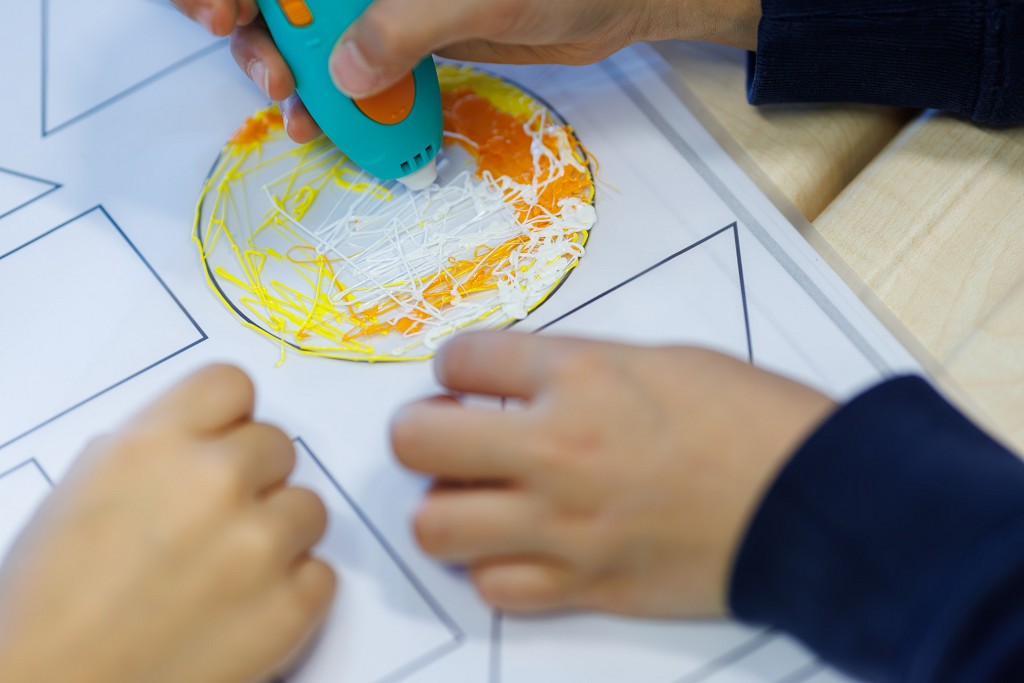
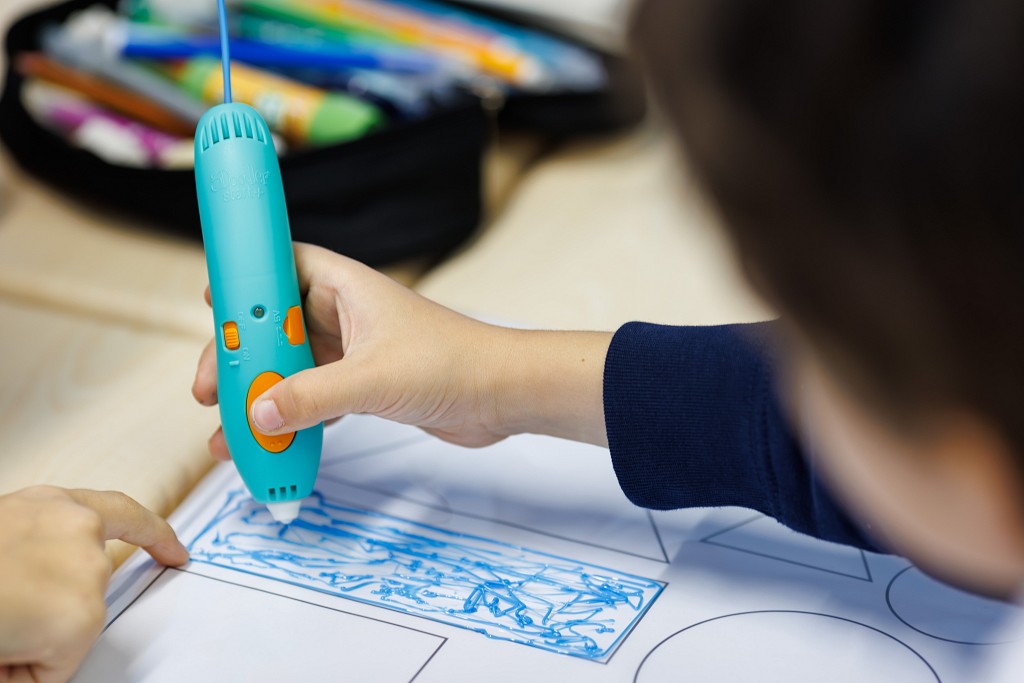
Once they understood the principle, the children moved from discovering patterns to creating their own, using 3D printing pens to make circles, triangles, squares, and rectangles that they could observe, touch, move, and combine. Geometry thus became tangible, allowing a mathematical idea to be constructed, viewed from different angles, and modified by the child.
In the PYP, student agency develops when children have space for their own ideas, make choices, and can make meaningful decisions about what they are creating. In this activity, the children decided which shapes they wanted to create, how they would arrange them, and what rule would organise their sequence. They used what they had just discovered in a new situation in which they were the ones deciding what the final result would look like.
The 3Doodler Start+ 3D pens brought technology naturally into this exploration, giving the children the opportunity to quickly transform an idea into a physical form that they could handle and modify. Designed for children aged six and above, the pens operate at 65°C, without hot external surfaces, and use a non-toxic, BPA-free, fully biodegradable ECO filament, allowing the children to work directly with the shapes they created.
The excitement of using a new tool quickly turned into focused attention on what they could do with it. The children experimented, compared different versions, and modified their models when the result did not match the idea they had started with. At the same time, they discovered that a first attempt can be adjusted, improved, and tried again. Perseverance and flexibility develop precisely in these moments, when children have the freedom to experiment and the confidence to keep going.
Learning is also built together
Working in teams made collaboration, one of the skills continuously developed in the PYP, a natural part of the activity. The children explained their ideas, listened to their classmates’ suggestions, compared solutions, and made decisions together. They gradually learned that another person’s perspective can complement, refine, or even change the way they see a problem.
After creating their shapes, each team designed a geometric sequence for their classmates, who then had to discover its rule, formulate a hypothesis, and test it. The children therefore moved from constructing a rule to decoding someone else’s, using the same mathematical understanding from different perspectives.
Equally important was the ability to explain the reasoning behind an answer. Identifying the triangle as the next shape shows that a child has found the solution, while explaining why they chose it makes their thinking visible. By putting their reasoning into words and listening to their classmates’ explanations, the children clarified their own ideas and discovered that there can be different paths to the same conclusion.
Patterns all around us
The exploration continued beyond the sequences created in the classroom, as the children began to look for and recognise patterns in nature, architecture, objects, art, movement, and familiar things from everyday life. Mathematics naturally connected with technology, creativity, and the exploration of the world around them. What the children had discovered in one context began to become meaningful in others as well.
These connections between different areas of learning are important in the PYP because they help children build an understanding that can extend beyond a single activity or subject. When a pattern observed in a geometric sequence is later recognised in a building, an image, or nature, the concept begins to become part of the way a child reads and understands the world around them.
By the end of the activity, the children had identified and continued sequences, worked with geometric shapes, and created their own patterns. Around these mathematical objectives, they had also practised observation, formulating and testing hypotheses, collaboration, communication, perseverance, and flexibility (observing, formulating and testing hypotheses, collaborating, communicating, persevering, and adapting). Knowledge and skills developed together within the same learning experience.
This is how the PYP takes shape in the everyday life of a Primary classroom: through experiences in which children are curious, engaged, and empowered to use their own thinking to move forward. The joy of discovering a rule independently matters in that moment, but so does the confidence that develops alongside it. When the answer is not yet obvious, children begin to understand how to search for it.
Authors:
Mihaela Zăuleț, Primary School Teacher
Zsofia Dumitru, Innovation Facilitator, STEAM IDEA HUB & Primary and Middle School Clubs Coordinator