When Mathematics takes shape: Pattern Detectives
Oct 6, 2026
HOW IB MYP CLASSROOMS ARE PREPARING STUDENTS FOR A WORLD TRADITIONAL TEACHING CANNOT ANTICIPATE
Imagine your child as a young adult, navigating the world beyond high school. They're sitting in a job interview, or maybe a university seminar, and someone throws them a curveball. They're having a tough conversation with a mentor, a colleague, or even a stranger who sees things from a completely different perspective. What do you want them to be equipped with in that moment? Do you want them to have a wealth of factual knowledge, like the periodic table, stored away in the back of their mind? Or do you want them to have something far more valuable, something that's harder to teach but will serve them well in the long run: the ability to stand their ground with confidence and thoughtfulness, to push back without losing their cool or alienating others, and to feel comfortable with uncertainty: to be at home in the unknown, even when it's uncomfortable.
This scenario sounds incredibly familiar for most of us who are the products of the "drill and kill" tradition. A teacher who commands the room. A curriculum that moves forward regardless of who is following. Notebooks filled with information transferred, more or less faithfully, from one generation to the next. Tests that reward whoever memorized the most completely.
This is a system that has unquestionable merits because it instilled discipline, among other invaluable qualities. It produced doctors, engineers, and mathematicians who went on to distinguished careers. The Romanian educational tradition, at its best, created people with formidable analytical minds, built on a foundation of genuine subject-matter depth. The blunt reality is we are no longer in the world that system was designed for, and both educators and parents must confront this reality.
As it were, the system was built for an economy that needed reliable, disciplined executors of known tasks. Yet, without a doubt, that economy is not your child's future. The World Economic Forum's Future of Jobs Report (2023) identified the top skills demanded by employers through 2027: analytical thinking, creative thinking, resilience, motivation, self-awareness, and curiosity. Once more, educators are faced with the reality that not one of those skills is developed by copying notes from a board.
David Perkins of Harvard's Project Zero, whose work on "lifeworthy learning" remains among the most cited in contemporary education, argues that the traditional curriculum is dominated by what he calls "inert knowledge": facts and procedures that students can reproduce on demand but cannot transfer, apply, or build on in genuine contexts. At Genesis College, we implement the IB framework, one that was designed to tackle this very issue.
WHAT AN IB MYP CLASSROOM ACTUALLY LOOKS LIKE
When it comes to education, phrases such as "inquiry-based learning" and "student-centered pedagogy" have been diluted to meaninglessness by overuse. What do they actually mean at eleven o'clock on a Tuesday?
At Genesis College, in a history class, students are not just reading about the causes of the First World War. They are reading primary source documents, such as letters from soldiers, political telegrams, and newspaper front pages from 1914, and are asked to construct their own causal argument, citing specific evidence, and then defending that argument against a classmate who has reached a different conclusion. The teacher's job is to design that encounter, to ask the right disruptive question at the right moment, and to help students understand why their reasoning is or is not convincing.
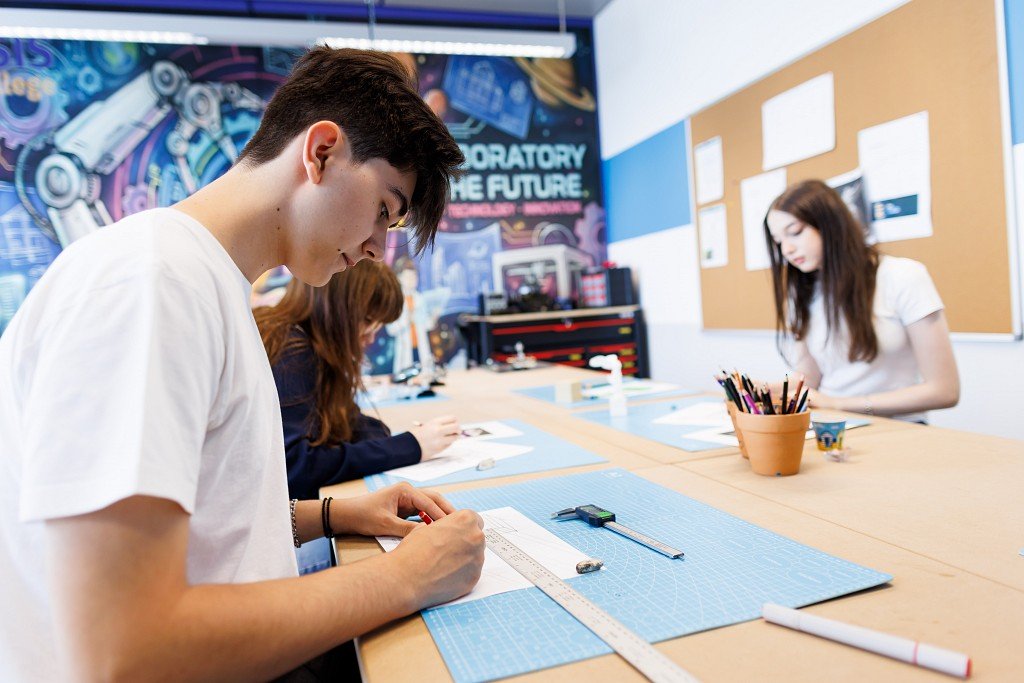
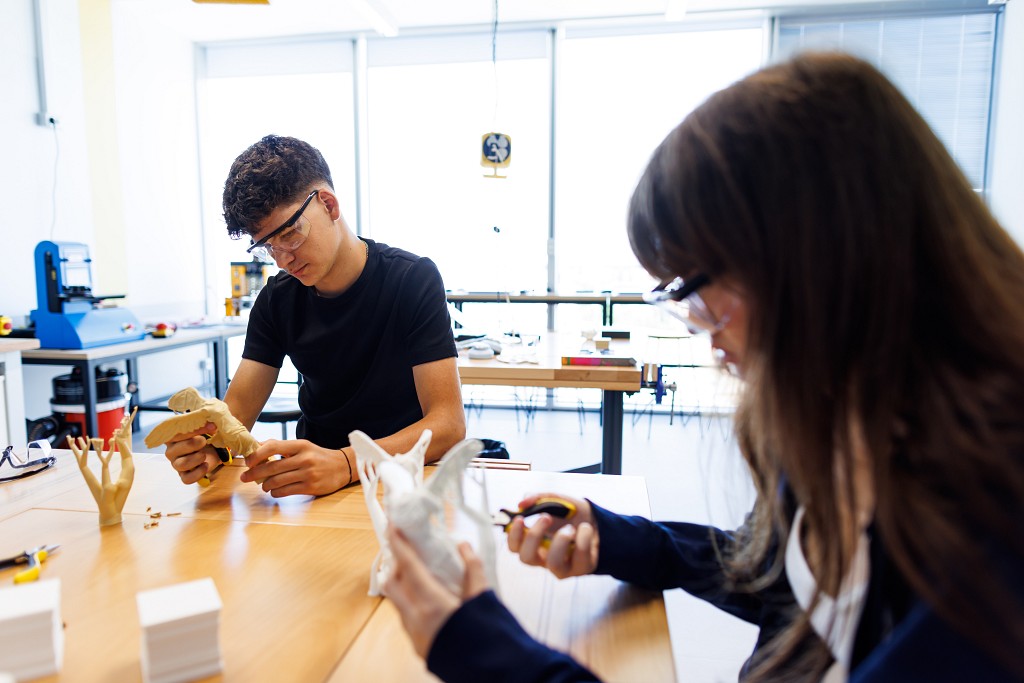
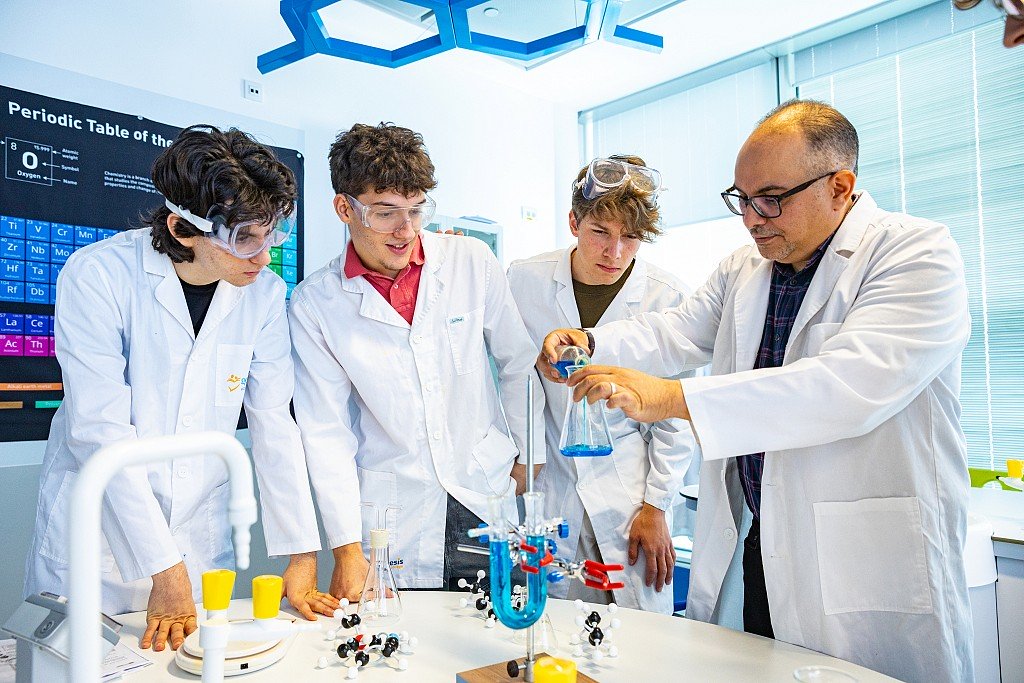
In a sciences class, a student is not performing an experiment whose outcome is known in advance. Instead, they engage in a more meaningful pursuit. You'll see them designing something by first coming up with an idea, figuring out what might affect the outcome, planning how to test it, gathering information, and then checking if what they found actually matches what they thought would happen. If this process sounds like the steps of the scientific method, that's because it is. Students learn that the world doesn't always turn out as expected, and that's what makes it science: the very hands-on approach students embrace. We allow them to experience firsthand that things don't always go as planned, as we allow them to learn to trust their judgment.
Similarly, in mathematics, students are not drilling fifty variations of the same equation. Instead, they are using mathematical tools to model a real economic scenario, perhaps the projected growth of the population in Bucharest or the financial structure of a solar energy installation, as the teacher showcases that abstraction has a purpose they can see and interrogate.
THE COLLABORATION QUESTION AND WHY IT IS NOT REDUNDANT
More often than not, parents express concern about collaboration. "Isn't that just letting the stronger students carry the weaker ones?" It is a fair question, and it deserves a serious answer.
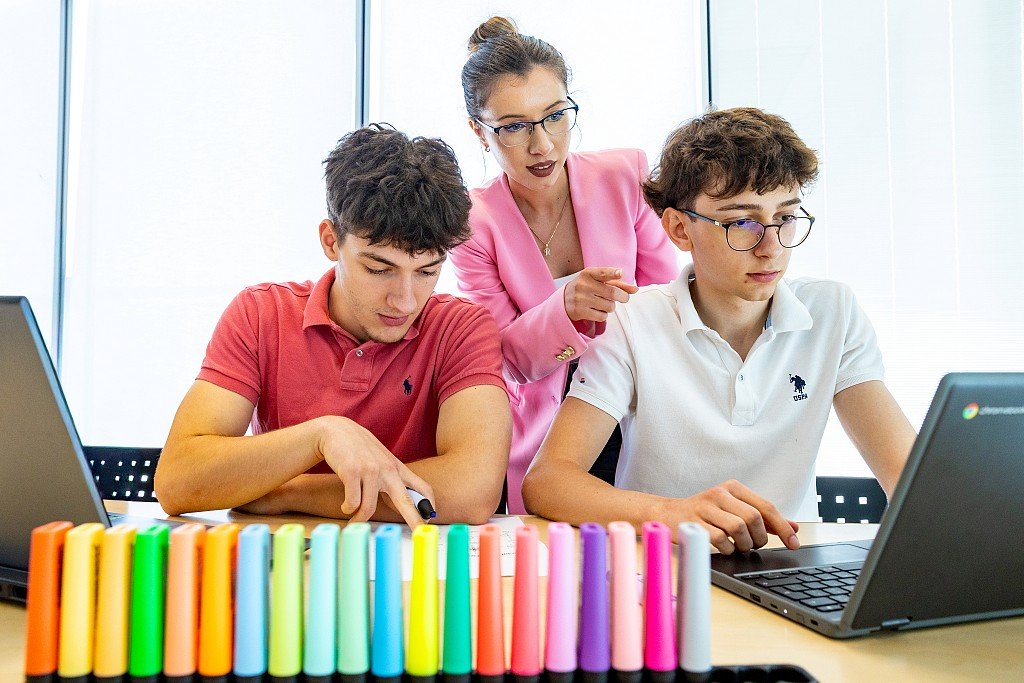
True collaborative learning is not group work in the sense you may remember: one person doing everything while others coast. Conversely, it is structured interdependence; a process in which each student has a role, a deliverable, and accountability to the group. In this manner, they are assessed individually on their contribution because it is the teacher that designs the conditions so that no one can succeed without genuinely engaging.
Amy Edmondson's research on "psychological safety" showcases that the conditions for genuine collaboration are specific and learnable. More precisely, they include the confidence to propose an imperfect idea, the willingness to challenge a flawed one, and the emotional maturity to separate disagreement from disrespect. What we might be tempted to define as personality traits, these students acquire through learning experiences in the MYP and DP IB classrooms.
When your child sits in a boardroom in 2035, the room will include people from Bucharest and Berlin, Lagos and Seoul, who have been trained in different systems and reason from different frameworks. In those moments, the very ability to navigate that environment with intellectual confidence and genuine curiosity about other minds will be worth more than any grade they ever received.
ARTIFICIAL INTELLIGENCE HAS CHANGED WHAT "BEING EDUCATED" MEANS
Let's be honest about something that most school brochures won't say. ChatGPT passed the US medical licensing exam and writes legal memos that senior partners struggle to distinguish from junior associate work. Moreover, it can summarize an entire body of research in the time it takes to make coffee. Therefore, one will ask: "What, precisely, are you investing in when you choose a school for your child?"
If the answer is knowledge, that same accumulation of facts and content that can be reproduced under exam conditions, then that investment is worth considerably less than it was a decade ago. Access to information is now free, instant, and effectively infinite, and the student who memorized the most is no longer competing in a race that matters.
What artificial intelligence cannot do, at least not with any reliability, is exercise genuine judgment. It cannot take full ownership of an argument and defend it credibly when someone intelligent and skeptical pushes back. It cannot navigate real moral complexity, the kind where every available option carries a cost, and arrive at the right conclusion. It cannot generate the question that changes the direction of a conversation, the one nobody in the room had thought to ask. In other words, the distinctly human capacities which produce real discomfort, the ones that traditional schooling does not develop in any structured way, because fast and accurate retrieval is more convenient, and precisely what AI already does, and does better.
At Genesis College, technology is not banned, nor is it treated as a magic answer. Students are taught to ask: Who built this tool? What data trained it? What does it get wrong, and why?
Here is something I want to be honest with you about: the framework is only as good as the educators who implement it.
A truly skilled IB teacher is hard to find because they need to know their subject inside out, and they need to possess a high degree of adaptability. On top of that, they also need what researchers call "pedagogical content knowledge": the understanding of how students actually come to understand and where and what questions will unlock their thinking. In other words, they need, frankly, a kind of ego flexibility that not every experienced teacher possesses: the willingness to let a lesson go somewhere unexpected, to say "I don't know; let's find out together," and to design an assessment that cannot be gamed by rote preparation. In all honesty, this endeavor is harder than standing at a whiteboard. However, when done well, it is also far more demanding intellectually, for both teacher and student.
When you visit a school, watch the teachers. Ask them what they most enjoy about their work. The answer tells you almost everything. A teacher who says "I love when a student surprises me" is operating in a fundamentally different mode from one who says "I love how well my students perform on assessments." Both have value. But only one is consistently developing the kind of mind your child will need.
THE QUESTION BENEATH THE QUESTION
As a parting thought, I want to remind you of the distinction Michael Fullan makes between schools that are effective and schools that are powerful. Effective schools produce strong results within the current system, while the latter change what a student is capable of long after they've left. As a rule, most parents are looking for effective schools, and reasonably so. The exam results, the university placements, the rankings. These are legible and reassuring. Nonetheless, if you've read this far, I suspect you're after something harder to measure. Not which school performs best, but which one will shape how your child actually thinks. What they reach for when a problem has no clean answer.
The International Baccalaureate Middle Years Program is one of the few secondary education frameworks that focus on the more challenging aspects of learning. While it has its drawbacks, the program's success largely depends on the quality of its teachers and the overall culture of the school. However, students who graduate from this program often possess a unique set of skills that can't be measured by traditional grading systems. They tend to be well-equipped to handle pressure, think critically, and adapt to changing circumstances, even when faced with opposing viewpoints. And, most importantly, this ability to learn and thrive in dynamic environments is a valuable asset that serves them well when they transition to higher education.
Your child has roughly a decade of formal schooling ahead. That decade will either build a genuine relationship with their own thinking (curious, resilient, intellectually confident) or it will train them to perform within a system that is already changing faster than the system itself recognizes.
You are on the right track just by asking the right questions, and that is a big part of it.
Admissions Are Now Open
Families interested in learning more about the high school or scheduling a visit to the Genesis College campus are warmly invited to contact the Genesis College Admissions Team at admissions@genesis.ro.
Alexandra Petrescu, DP Coordinator @ Genesis College