
Filip & Company : Filip & Company assists Raiffeisen Bank Romania in providing financing to Booster Capital for the acquisition of Servicii Publice S.A.
Apr 29, 2026
When AI can generate code on demand, the argument for teaching children to program is no longer mainly about jobs. It’s about the thinking that programming builds: breaking a problem down, testing a solution, knowing what a result actually means, and when to challenge it.
In a world mediated by algorithms, that kind of reasoning is closer to foundational literacy, same as reading and arithmetic. And it needs to start early: in the Romanian curriculum, 5th and 6th grade is when these foundations either form or don’t.
Romania’s middle schoolers rank among the lowest in Europe on digital and computational literacy (ICILS 2023), and near the bottom of the OECD on creative thinking (PISA 2022). Not because of missing hardware or smart boards, but unsupported teachers and unclear curriculum.
Asociația Techsoup’s own classroom research* found that almost one in three middle school teachers either teaches less than 6 hours of coding in the whole school year or skips computational thinking units altogether in the 5th and the 6th grade. The typical lesson: students transcribe an algorithm dictated by the teacher. No problem-solving, no real-world context, no teamwork, no argumentation of choices made in solving the problem.
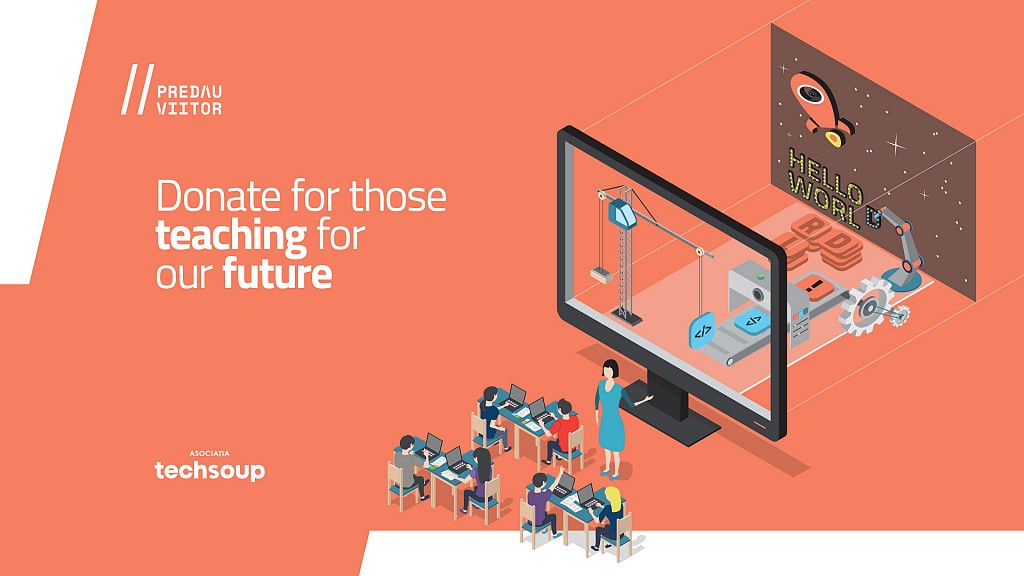
Teaching the Future is a national program for computer science teachers built around what our research shows is actually missing, focusing in the next year on building the 5th and 6th grade foundations in computational thinking. Teachers receive structured, curriculum-aligned lesson sets designed around an internationally validated University of Cambridge pedagogy, built around real-world problems, not abstract math exercises.
Over three years, we aim to reach 400+ teachers through this pedagogy, then connect them to plan, share practice, and hold each other accountable. For 5th and 6th grade students, this adds 10+ hours of genuine computational thinking instruction per year within existing school time. The program starts deliberately in rural schools, where the gap is deepest, and is designed to scale.
Redirect 3.5% of your income tax — it costs you nothing extra and funds all of this: https://redirectioneaza.ro/asociatia-techsoup
For institutional partnerships: sponsorizare@asociatiatechsoup.ro
—
Asociația Techsoup supports non-profit organizations, teachers, and their students in increasing their discernment and autonomy as users and creators of digital products. Our programs focus on civil society, digital citizenship, programming literacy, and artificial intelligence — at the intersection of critical thinking, creative thinking, computational thinking, and democratic culture. For 15 years, Techsoup has been serving communities that currently include over 5,000 non-profit organizations and 20,000 teachers in public education in Romania and the Republic of Moldova. Read more: www.asociatiatechsoup.ro
—
*Targeted survey of 200 Informatics and ICT teachers across all Romanian counties teaching at 5th and 6th grade, with 41% from rural schools, plus classroom observations and interviews, May–November 2025.