The Harmony of Code and Copyright: Intellectual Property in the Age of AI Music
May 13, 2026
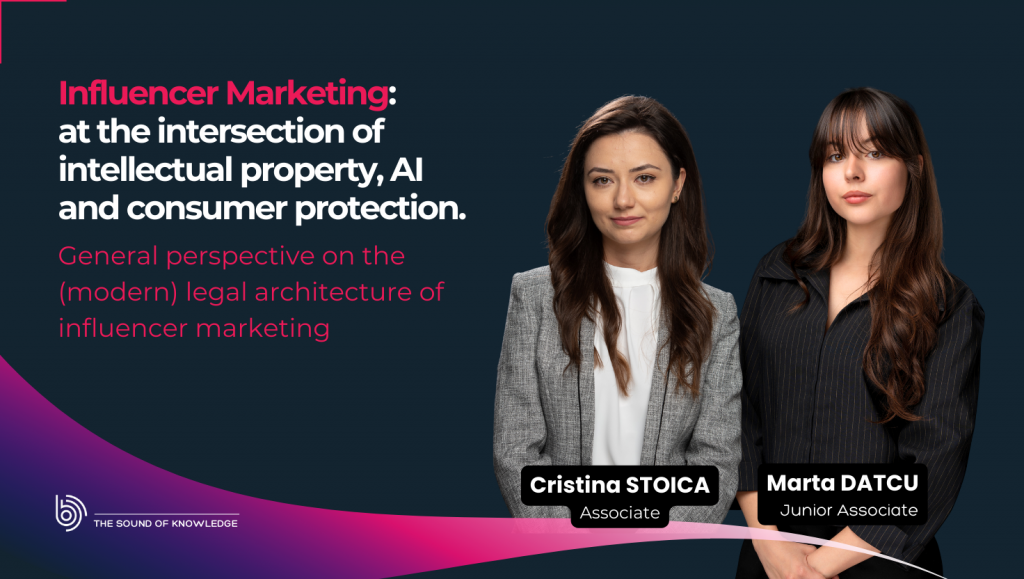
General perspective on the (modern) legal architecture of influencer marketing
Authors: Cristina Stoica, Associate; Marta Datcu, Junior Associate
In a digital ecosystem that evolves at a speed that makes FOMO seem like an outdated concept, influencer marketing has become an industry in itself, characterized by significant economic milestones and an accelerated degree of professionalization. The management of intellectual property rights becomes, in this format, a strategic element for differentiating "occasional creators" from professional influencers.
A recent study published by the EUIPO confirms the essence of the relationship between content creators, intellectual property (IP) rights and the increasingly complex challenges that their intersection with consumer rights highlights:
In essence, in an environment where information spreads extremely quickly, and protection mechanisms are not always straightforward, understanding IP rights can help content creators better manage their own brand and safeguard their ideas while respecting the rights of consumers and fellow content creators.
EUIPO’s initiative to encourage influencers to educate themselves about IP is welcomed as it provides useful training and resources to help them protect their own creations while achieving the immediate goal of strengthening their online presence.[1] At the same time, it’s worth noting that transparency and fairness in influencer marketing remain essential for protecting consumers. Upholding these principles shouldn’t be a simple goal, but a fundamental part of any truly professional content creator’s approach.
IP rights appear in many forms across various aspects of an influencer's activity: from the photos they post online and the trademarks of the brands they collaborate with, to a website name or even their own name used as a personal brand.
The first example is copyright, which protects original creations. Online, this can cover a short video made for a campaign, an original text posted on social media, or even elements like a meme or a creative hashtag.
Another common example is trademarks. Whether we are talking about a name or a logo, trademarks are essential for protecting the goods and services influencers offer through their platforms, such as fan merchandise, the name of a podcast, or even the influencer’s own name used in promotional activities
By gaining a solid understanding of intellectual property mechanisms, content creators can ensure that their work is not used without authorization and that their hard-earned reputation is protected.
For example, an influencer who has achieved success with a podcast might face a situation where a third party tries to launch a similar show under an almost identical name. Another scenario could involve a creator who has invested significant time and resources into a project, such as a photoshoot, only to have it used by another publication or individual without their consent.
Similarly, understanding IP mechanisms helps influencers avoid infringing the rights of others. A relevant example would be promoting counterfeit products as part of an online campaign. This aspect should not be ignored, given the very large number of counterfeit products identified annually by the authorities in the European Union, the frequency with which people who promote platforms selling such products appear online, as well as the risks related to consumer protection.
According to the European Commission, an influencer can be considered a trader - or act on behalf of one - regardless of their number of followers[2]. Thus, if you sell, promote or recommend products or services, you must comply with consumer protection rules.
This entails total transparency when content creation is paid for (money, free products, discounts, affiliation, invitations, trips, unsolicited gifts etc.), avoiding falsely presenting yourself just as an ordinary consumer; clearly disclosing any commercial purpose, refraining from providing false or misleading information; and not using direct appeals aimed at children etc.
Because they can influence consumers’ purchasing decisions, influencers are already under the supervision of the consumer protection authority - ANPC[3], which monitors how commercial intent is disclosed and how it affects consumers' online behavior.
Under the Digital Services Act (DSA), a European regulation that came into effect in 2024, online platform providers have specific obligations regarding illegal or harmful content, the promotion of counterfeit products, and advertising transparency. Consequently, if a creator uses platforms like TikTok, YouTube, or Instagram for promotion, they must ensure clear disclosure whenever their content promotes products or services and is sponsored.
Given that more and more content creators are using artificial intelligence for voiceovers, avatars or editing, it is useful to know the obligation to inform the public if they interact with an AI system (e.g. Chatbot) and to clearly label digital fakes (deepfakes).
It should be noted that fundamental rights and the prevention of risks associated with the harmful effects of artificial intelligence are protected by the so-called AI Act.[5]
Studies[7] show that many influencers do not fully comply with their obligations to disclose sponsored content, or even when they do, the information is still presented in a way that leads consumers to believe the content reflects a personal recommendation from the influencer.
As a result, the DFA aims to combat manipulative commercial practices, in line with the DSA and AVMSD[8], by setting clearer rules for sponsorship disclosure and defining responsibilities for both brands and influencers to ensure fair and transparent advertising. Stay tuned for the legislative proposal expected in 2026!
Through the Draft Decision on the procedure for licensing, authorization and notification of audiovisual media services, the CNA intends to extend the supervision to influencers and proposes the obligation to notify the Council for those who:
It should be noted that the CNA decision no. 573/2025 already prohibits advertising of medicines, dietary supplements and gambling by famous/notorious people.
Although the challenges are numerous and the legal framework is not always intuitive for a rapidly growing industry, the sustainable development of influencer marketing cannot occur without a rigorous approach to intellectual property, responsible use of artificial intelligence, and compliance with consumer protection rules.
These dimensions are not optional, but the foundations of a mature market, where content creators, brands and online platforms share the same responsibility - building and maintaining a credible, balanced digital ecosystem with a real impact both economically and digitally.
[1] IP for influencers, link here. At the level of the European Union, similar guides and initiatives have already been developed, both in the field of copyright (details here) and industrial property (details here), and more generally through the launch of the Influencer Legal Hub (available here).
[2] Directive 2005/29/EC on unfair business-to-consumer commercial practices in the internal market (link here), transposed into national law by Law no. 363/2007 on combating unfair practices by traders in relation to consumers and harmonising regulations with European consumer protection legislation; Chapter 2.4.6. marketing by influencers in the European Commission's Guidelines 2021/C 526/01 on the interpretation and application of Directive 2005/29/EC (here link);
[3] The National Authority for Consumer Protection started in 2023 an action to verify the Instagram accounts of Romanians with Influencer status online, link here;
[4] Regulation (EU) 2022/2065 on a single market for digital services, link here;
[5] Regulation (EU) 2024/1689 laying down harmonised rules on artificial intelligence, link here;
[6] Digital Fairness Act (DFA) | Updates, link here;
[7] Commission Staff Working Document Fitness Check on EU consumer law on digital fairness, link here;
[8] Audiovisual Media Services Directive
[9]Link here.